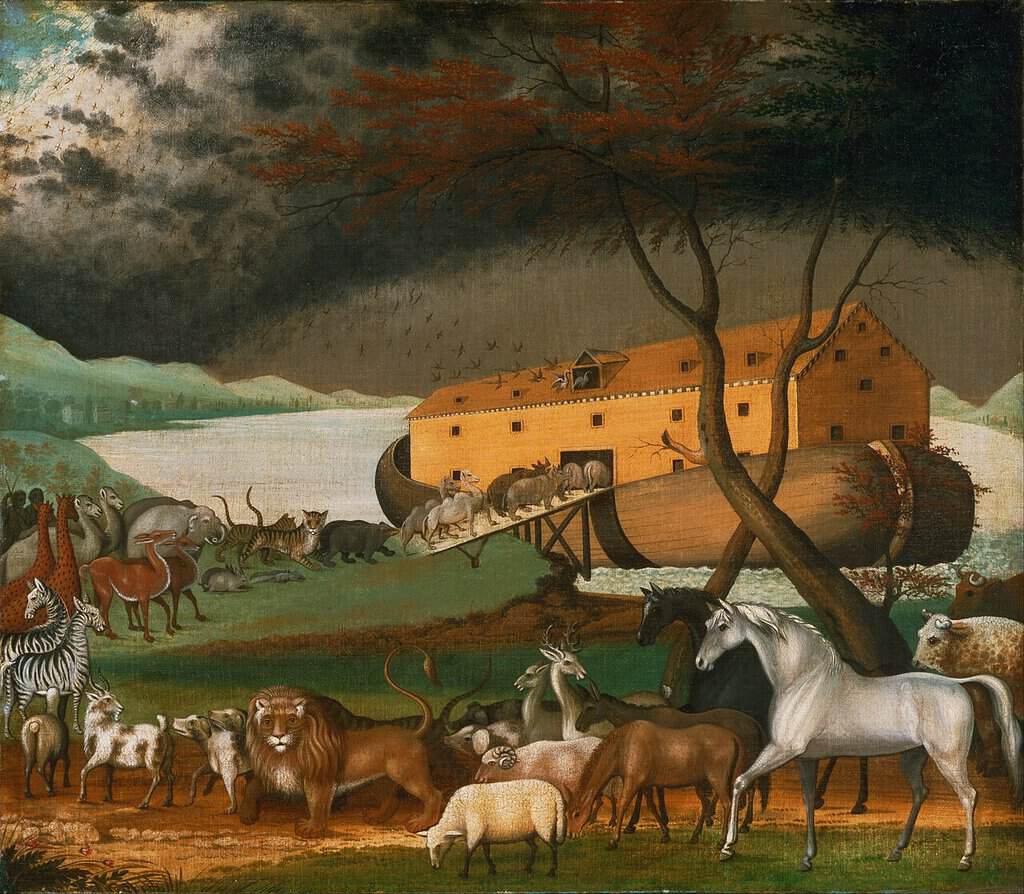
Noah’s Ark (1846), by Edward Hicks Public Domain, https://commons.wikimedia.org/w/index.php?curid=21886421
There are two delicious ironies at the heart of this story.
The first: the fire meant to destroy a library instead preserved it. The second: the expedition funded to confirm the Bible instead undermined it.
A Story You May Think You Know
God, troubled by the noise and wickedness of humanity, decides to send a great flood to destroy all living things. He confides in one righteous man, and instructs him to build a great boat to specific dimensions. The man loads his family aboard, along with pairs of all the animals. The flood comes. Everything outside the boat perishes. After many days, the waters begin to recede, and the boat comes to rest on a mountain. The man sends out a dove, which returns to the boat – there is nowhere to land. He tries again, and this time the dove returns with a freshly plucked olive leaf. On the third attempt, the dove does not return at all. He disembarks. He builds an altar and makes a burnt offering. God smells the aroma and is pleased, and resolves never to destroy humanity by flood again.
If you think this is Noah, think again. The righteous man is Utnapishtim. The story comes from Tablet XI of the Epic of Gilgamesh. And it was written down at least a thousand years before Genesis.
The parallels are not vague thematic resonances. They are beat-for-beat plot correspondences: the divine decision to flood, the chosen survivor, the boat built to specification, the animals loaded in pairs, the mountain landing, the sequence of birds sent to find land, the burnt offering producing a pleasing aroma. The specific detail of the olive leaf does appear to be distinctive to Genesis – but the structure around it is unmistakably shared. At some point, the story of Utnapishtim was reworked, monotheized, and attributed to Noah. Scholars today almost universally agree on the direction of borrowing: the Mesopotamian account came first.
And That Is Not the Only Story
The flood is the most dramatic parallel, but it is not the only one.
Enkidu, Gilgamesh’s companion, begins his existence as a wild man, living naked among animals, communing with nature, at peace in a state of primal innocence. He is introduced to Shamhat, a woman, who initiates him into the world of civilization. Afterward, the animals shun him. He cannot return to the wild state he came from. He has, in the language of one tradition, fallen.
The resonances with Adam and Eve are strong enough that serious scholars have been drawing the comparison since 1898, when University of Pennsylvania professor Morris Jastrow proposed in an academic journal that Enkidu and Shamhat had been recast as Adam and Eve in Genesis. Both stories feature: a man formed from the earth, living in innocent communion with animals; a woman whose intervention marks the boundary between innocence and experience; and a subsequent loss of the primal state, involving separation from the animal world. Gilgamesh also contains a plant of immortality that is stolen by a snake, which again maps suggestively onto the Tree of Life and the serpent of Eden.
The garden story is more contested among scholars than the flood since the parallels are structural rather than verbatim. But the cumulative picture is of a set of biblical origin narratives that are clearly drawing on a rich pre-existing tradition.
The Liberal and the Literalist
It is worth pausing here to note that not all Christians find this troubling. Many theologically liberal Christians have long accepted that the early chapters of Genesis are not straightforward history. They are origin stories – profound, theologically rich, and deeply human – but not a newspaper report. If God can work through human authors with all their cultural context, it is not particularly surprising that those authors drew on the stories of their world. The flood account in Genesis is, on this view, a theological reflection on an existing tradition: retold with a single God rather than a quarrelsome pantheon, emphasizing human moral responsibility, and ending with a covenant rather than a grudging divine concession. The story is adapted to emphasize the novel elements of the syncretically emerging religion, not invented.
Biblical literalists face a harder problem. If Genesis is direct historical reporting, then the details matter. And if the details of a Mesopotamian epic from centuries earlier match those details almost exactly, the question of origin becomes unavoidable. The most natural response (a fave among fundamentalists, along with the ever ready “context” excuses) is to question the dating. Perhaps the Gilgamesh epic was inspired by the Hebrew scriptures, not the other way around?
This hypothesis is not seriously entertained by scholars today. Here’s why.
The Evidence for Priority
The case that the Gilgamesh tradition predates the biblical one rests on several independent lines of evidence that converge on the same conclusion.
The physical tablets. The earliest surviving Sumerian poems about Gilgamesh have been dated to approximately 2100 BCE on the basis of paleography – the study of how scribal handwriting styles evolved over time, a well-established dating technique. The Old Babylonian unified epic dates to approximately 1800 BCE. By contrast, even scholars who favor an early date for the composition of the Pentateuch place its final form no earlier than the 10th century BCE, and most mainstream scholarship dates the relevant portions of Genesis to between the 8th and 5th centuries BCE. The physical artifacts predate the biblical text by centuries on any reasonable accounting.
The geographic spread. Versions of the Gilgamesh epic have been found across Mesopotamia, Anatolia, and the Levant – meaning the story was circulating widely across the ancient Near East for over a thousand years before the Torah reached its final form. This is not an obscure Babylonian curiosity that the Israelites could plausibly have been unaware of. It was the regional background mythology, as familiar in that world as the stories of Zeus were in ancient Greece, or Jesus is in modern America.
The Babylonian exile as mechanism. The direction of cultural transmission is not mysterious. In the 6th century BCE, the Israelites were taken into Babylon, the very civilization that had inherited and preserved the Gilgamesh tradition. This is also, not coincidentally, the period in which scholars believe much of the Torah was being compiled and edited in something like its final form. The scribes who shaped Genesis were living in Babylon, surrounded by its literature, its temples, its stories. You do not need to posit mysterious long-distance borrowing across centuries: the contact was direct, documented, and historically uncontroversial. In fact, the Bible is just obviously referring to a known tradition, and changing it in certain ways to make a point.
The irony of the original expedition. Perhaps the most telling detail of all is this: the archaeological excavations that uncovered the Gilgamesh tablets were explicitly funded by Western institutions wanting to find physical evidence to confirm the Bible. Austen Henry Layard, who discovered the library of King Ashurbanipal at Nineveh in the 1840s, went to Mesopotamia as a believer, looking for corroboration. He, and the self-taught engraver George Smith, who later decoded Tablet XI, were not skeptics seeking ammunition against religion. They were people shaped by the same Victorian culture that treated Genesis as the oldest book in the world. What they found instead were much older texts, in a library that had been accidentally baked into ceramic by the fire that destroyed Nineveh in 612 BCE – preserved for two and a half millennia by the very catastrophe intended to erase them. It is a testament to their intellectual integrity that they reported the Babylonian priority accurately.
Summary
The Epic of Gilgamesh contains a detailed flood narrative – featuring a righteous man, a great boat, pairs of animals, a mountain landing, a sequence of birds, and a burnt offering – that predates the Genesis account by at least a thousand years and was widely circulated in the ancient Near East for centuries before the Torah was compiled. It also contains structural parallels to the Eden narrative. These are not coincidences. The scholarly consensus is clear: the direction of borrowing runs from Mesopotamia to the Hebrew scriptures, not the other way around.
Liberal Christians may find this unremarkable – God working through human authors drawing on human traditions is entirely consistent with their theology. For those committed to the literal historical accuracy of Genesis, however, the story of Gilgamesh is genuinely difficult to absorb. The flood of Noah did not originate with Noah. It originated, as best we can tell, with Utnapishtim – and with the unnamed scribes who first pressed his story into wet clay, sometime around the Third Dynasty of Ur, more than four thousand years ago.


