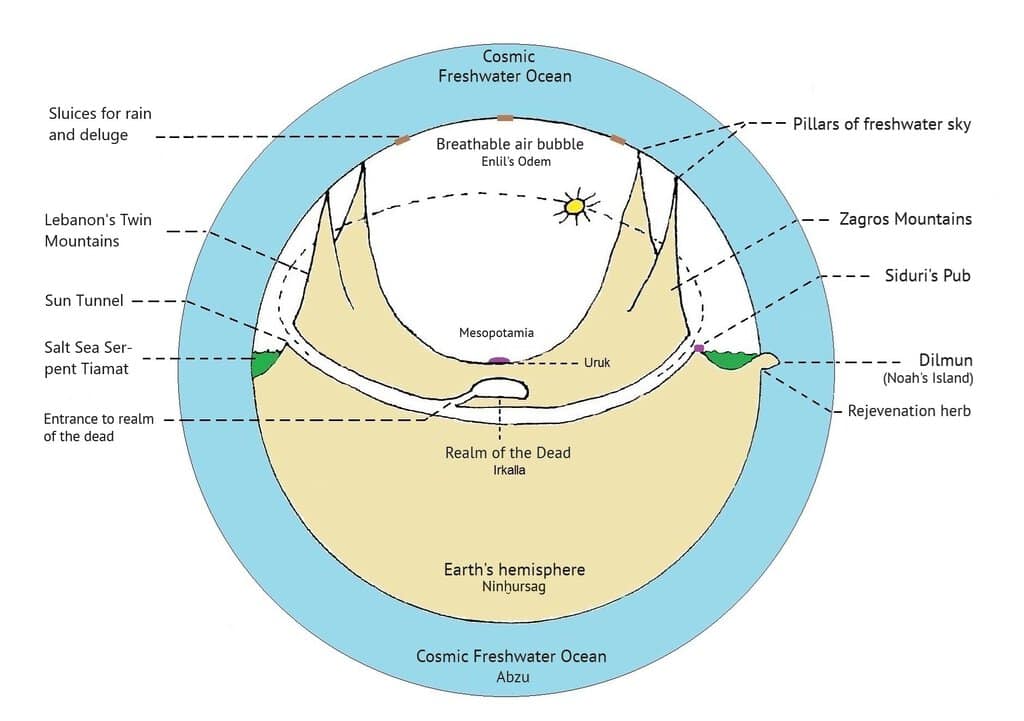
Carlos Gutiérrez Sáenz (From the Work “Enkidu and Gilgamesh”), CC BY-SA 4.0, via Wikimedia Commons
The argument from what doesn’t get said
When I tell you about something that happened on Earth, I don’t pause to mention that the Earth is roughly spherical, that it orbits the sun, that the sun is one of many stars, or that the stars are very far away. These facts are background. They sit underneath everything I say, but I don’t have to articulate them. If you went looking for an explicit statement of “the Earth is a sphere” in my writing, you might come up empty – not because I doubt it, but because it goes without saying. I wouldn’t explain that on clear days, I have seen the tops of ships as they come over the horizon before seeing the bottom, for example, because I wouldn’t feel the need to justify this worldview to (the majority of) readers.
This matters because it changes what counts as evidence about a writer’s worldview. We don’t need a sentence in which an author says “I believe the Earth is flat.” We can ask, instead, whether the background assumptions of the writing fit a flat Earth or a spherical one. Does the imagery work? Does the geography make sense? Do the casual asides cohere with one cosmology and break under the other?
Applied to the Bible, the question becomes: what model of the Earth and the heavens are these authors taking for granted when they reach for a metaphor, narrate a vision, or describe what God is doing?
My contention is that the model they assumed is the one their neighbors assumed – a roughly flat Earth, often resting on pillars or foundations, with a solid dome (the firmament) above it, holding back the waters that exist over our heads. This is sometimes called the “ancient Near Eastern” or “Hebraic” cosmology, and it would be odd if the biblical authors had broken from it, given how culturally embedded it was.
A caveat before I begin: the Bible is not one book. It has many authors writing across roughly a thousand years, in different genres and contexts. There is no reason to expect them to agree with one another about cosmology any more than they agree about other things. Some passages are stronger evidence than others, and some authors may have held more sophisticated views than their contemporaries. The argument is not that every biblical author held an identical, articulated flat-Earth model. It’s that the weight of the evidence, taken across the corpus, is far more consistent with the Hebraic cosmology than with anything resembling a modern view.
The Hebraic cosmology in brief
Before going to the texts, here is the model I’ll be testing them against:
The Earth is a roughly flat disk or rectangle, with definite edges (“the ends of the earth,” “the four corners of the earth”). It rests on pillars or foundations sunk into the deep. Beneath it are the subterranean waters and Sheol. Above it is a solid dome, the raqia, (translated ‘firmament’) in which the sun, moon, and stars are set. Above the dome are more waters – the “waters above” – which can be released through “windows” or “floodgates” to produce rain or, in extreme cases, a flood. The sun travels across the underside of the dome each day and returns to its starting point at night.
This is not a model I am inventing. It is the cosmology widely attested in Babylonian, Egyptian, Canaanite, and Israelite texts of the period. The question is whether the biblical writers assumed it.
The Bayesian setup
I will be explicit about how I’m weighing the evidence using a Bayesian framework, but you can ignore this bit if it’s not interesting to you. I did something similar in Paul the Deluded Apocalypticist.
For each passage, I’ll be asking two questions:
- P(E | flat): How likely is this particular passage, with this particular language and imagery, if the author held the Hebraic flat-earth-with-firmament cosmology?
- P(E | modern): How likely is this same passage if the author held something like a modern (spherical-earth) cosmology, or if their writing was being directly guided by an entity who did?
The ratio of these two – the likelihood ratio, LR – tells us how strongly that passage favors one hypothesis over the other. If LR is much greater than 1, the passage favors the Hebraic view. If LR is much less than 1, it favors the modern view. If LR is around 1, the passage is neutral and shouldn’t move us.
To get a posterior probability, we take our prior odds (before looking at the texts) and multiply by the product of the likelihood ratios from each piece of evidence.
A note on prior odds: a reasonable starting prior for “the authors held the cosmology of their time and place” is fairly high, since this is true of nearly everyone who has ever written anything. The prior for “ancient Israelites had access to information about the spherical Earth that wouldn’t be derived for centuries, and quietly encoded it into their writings without ever stating it plainly” is low. So even before looking at the verses, the burden is heavily on the apologetic side, so probably 90:10. But let’s be generous and call it 50:50.
1. Genesis 1 and the raqia
The single most important word in Genesis 1 is the Hebrew raqia (רָקִיעַ). It appears in Genesis 1:6-8:
6 God said, “Let there be an expanse in the middle of the waters, and let it divide the waters from the waters.” 7 God made the expanse, and divided the waters which were under the expanse from the waters which were above the expanse; and it was so. 8 God called the expanse “sky”. (WEB)
Modern translations sometimes render raqia as “expanse” or “vault,” which sounds vaguely poetic and unobjectionable. But the word has a concrete meaning that can be checked against its other uses. Raqia is a noun derived from the verb raqa (רָקַע), which means “to beat out” or “to spread out by hammering.” It is the verb used elsewhere in the Hebrew Bible for hammering metal into thin sheets – for example, in Exodus 39:3 (beating gold into thin plates for the priestly garments) and Numbers 16:39 (hammering bronze censers into a covering for the altar). Job 37:18 directly applies the cognate verb to the heavens themselves: “Hast thou with him spread out the sky, which is strong, and as a molten looking glass?” The image is unmistakable: a solid metal sheet, hammered out and stretched across the sky.
The Septuagint, translating into Greek a few centuries before Christ, rendered raqia as stereōma (στερέωμα) – “a solid structure.” The Vulgate followed with firmamentum, “a firm thing.” Translators across two languages, with no axe to grind in the modern flat-Earth-versus-spherical-Earth debate, all heard the word as referring to a solid object.
What does this solid dome do? It “divides the waters from the waters” – it holds back a body of water above it. Then, in Genesis 1:14-17, God places the sun, moon, and stars in (Hebrew b’-) the raqia. Not above it, not beyond it. In it. The luminaries are embedded in the dome.
The flood account in Genesis 7:11 reinforces the picture. When the flood begins, “all the fountains of the great deep burst open, and the sky’s windows opened.” The raqia has windows, and the water also comes from below, completely consistent with the image shown. Water comes through them when God permits it. Genesis 8:2 closes the windows again when the flood ends.
Likelihood assessment: It’s very clear that Genesis 1 is riffing on earlier Babylon creation stories, so it makes sense that it has the same basic cosmology. The vocabulary is concrete, the imagery is consistent across Genesis 1 and Genesis 7-8, and the ancient translators understood it the same way. P(this language | Hebraic cosmology) is essentially 100% – this is exactly what you would expect such an author to write. P(this language | modern cosmology) is very small – on a spherical-earth view there is no dome, no waters above, no windows in the sky, and no obvious reason for an author with that knowledge to use such language without qualification. Let’s call it 10%. So this adjusts our 50:50 to 91:9.
2. The commandment about graven images
The commandment against graven images (numbered as the first or second of the Ten Commandments, depending on tradition) reads:
“You shall not make for yourselves an idol, nor any image of anything that is in the heavens above, or that is in the earth beneath, or that is in the water under the earth (Exodus 20:4, WEB)
This is interesting because it is a casual aside. The point of the verse is to forbid idol-making, and the structure of the cosmos is mentioned only as a way of saying “anything anywhere.” The author is not setting out to teach cosmology; he is simply gesturing at the entirety of creation. And the gesture has three layers: heaven above, earth in the middle, and water beneath the earth.
This three-tiered model – sky over land over subterranean waters – matches the Hebraic cosmology exactly. It does not match the modern view, in which there is no “water under the earth” as a structural feature of the cosmos; there are oceans on the surface and groundwater locally, but they are not a tier in some vertical layering of reality.
The verse is particularly striking if one believes, as some traditions do, that God personally wrote the Decalogue on stone tablets. In that case, the cosmology is not merely the assumption of a human author but the explicit framing of the divine author. An omniscient being electing to describe the cosmos using the wrong model – the model of his iron-age audience rather than the actual structure of his creation – would be an odd choice.
Likelihood assessment: Strong evidence for the Hebraic view. The casualness of the reference is part of the strength: the author isn’t trying to make a cosmological point, which means we are getting a clean read on his background assumptions. The “water under the earth” is the most distinctive element, since it is structurally present in the Hebraic model and structurally absent in the modern one. As an aside, clearly this wrong cosmoslogy implies that it wasn’t written by God (as addition to the general inadequacy of the ten commandments as I’ve written elsewhere). If the human author had a Hebraic view, we’d expect them to write like this, so 100%. If they had a modern cosmology, it would be weird. Generously, let’s call it 10%. So this adjusts our ratio to 99:1.
3. The sun racing back in Ecclesiastes 1
The sun also rises, and the sun goes down, and hurries to its place where it rises. (Ecclesiastes 1:5, WEB)
The verb translated “hurries” is sho’ef (שׁוֹאֵף), which means “to pant” or “to gasp eagerly” – it carries a sense of urgent, breathless travel. The image is concrete: the sun, after setting in the west, rushes back to the east in time to rise again the next day.
This makes immediate sense in the Hebraic cosmology. The sun is set in the dome of the sky. It moves across the underside of the dome during the day, sets at the western horizon, and then has to get back to the eastern horizon overnight – presumably by traveling under the earth, or behind some screen at the edge of the world. Various ancient cultures had different versions of this story, but they all required the sun to physically return to its starting point.
In a heliocentric model, the sun does not move in this way at all. The Earth rotates; the sun stays roughly where it is. The sun does not “pant” or “hasten” anywhere. There is no “place where it arose” that it needs to get back to.
One can, of course, read the verse as a poetic description of how the sun appears to move from a human perspective. This is a fair point, and we shouldn’t overweight a single poetic verse. But two things are worth noting. First, even taken as a description of appearances, the verse describes the sun returning to its starting point, which is not what the apparent motion of the sun does in a 24-hour period – the sun appears to trace a continuous arc, not to set in the west and then race back through the night. The verse describes the underlying mechanism, not just the visible motion. Second, Ecclesiastes is doing philosophical work here. The point is the futility and repetition of nature. The illustration is being chosen because it is true, not just because it sounds nice.
Likelihood assessment: Moderate-to-strong evidence for the Hebraic view. The specific language of the sun hastening to its starting point describes a mechanical return, not an apparent motion. Under a hebraic view, this is 100% likely. Generously, it’s 20% under a modern cosmology. So 99.8:0.2.
4. Shaking the Earth out by its edges
12 “Have you commanded the morning in your days,
and caused the dawn to know its place,
13 that it might take hold of the ends of the earth,
and shake the wicked out of it? (Job 38:12-13, WEB)
This is one of God’s rhetorical questions to Job. The image is striking once you see it. The dawn grabs the earth by its ends – its edges – and shakes it, the way you would shake a rug or a blanket, and the wicked tumble out.
The image only works if the earth has edges to grab. A sphere does not. You cannot pick up a ball by its corners. The metaphor presupposes a flat surface with definite boundaries – a tablecloth, a sheet, something with edges that can be gripped.
This is a poetic passage, and one shouldn’t push poetry too hard. But poetic imagery still tells you something about the writer’s underlying picture of the world. We do not, today, write poems about the dawn shaking the earth out by its corners. The metaphor would not occur to us, because our picture of the earth doesn’t support it.
A related image appears in Job 38:4-6, where the earth has foundations and a cornerstone – the language of a building, not a planet. And in Isaiah 40:22, the heavens are stretched “as a curtain” and “spread out as a tent to dwell in” – imagery of a fabric stretched over a flat surface.
Likelihood assessment: Moderate evidence. Poetic, so the likelihood ratio is smaller than for the more direct passages, but the metaphor is genuinely incompatible with a spherical-earth picture. 100% likely under the Hebraic cosmology, and generously 20% likely under modern cosmology. So the ratio is 99.96% : 0.04%.
5. Other verses that fit the pattern
A few additional passages are worth noting briefly, because they reinforce the picture without being load-bearing on their own.
Pillars and foundations of the earth. “For the pillars of the earth are Yahweh’s. He has set the world on them.” (1 Samuel 2:8). “He shakes the earth out of its place. Its pillars tremble.” (Job 9:6). “He laid the foundations of the earth, that it should not be moved forever.” (Psalm 104:5). These passages assume the earth is supported on something – it has a bottom that needs holding up. A spherical earth in space has no such structural feature.
The four corners of the earth. “The four corners of the earth” appears in Isaiah 11:12 and again in Revelation 7:1, where four angels are described as standing on them. The phrase, like “the ends of the earth” (which appears dozens of times), assumes definite boundaries.
Daniel’s vision. Nebuchadnezzar’s vision in Daniel 4:10-11 features a tree “in the middle of the earth” whose “sight [was] to the end of all the earth.” For a tree to be visible from every part of the earth requires a flat earth (and unobstructed line of sight). On a spherical earth, no object, however tall, is visible to every point on the surface.
Matthew 4:8. “Again, the devil took him to an exceedingly high mountain, and showed him all the kingdoms of the world and their glory.” This is a New Testament passage, written in Greek, presumably by an author who knew of Greek geography. And yet the temptation narrative requires that there exist a mountain from which all kingdoms can be seen at once. On a spherical earth, no such mountain can exist – the curvature of the planet hides distant regions regardless of altitude. The verse only works as written under flat-earth assumptions.
Each of these is, on its own, modest evidence. But the cumulative weight matters. The biblical authors reach for these images repeatedly and across many books, with no apparent self-consciousness about them. In fact, to this day, there are Christians who believe in a flat-earth because it’s so clear to them that the Bible says so, even in the face of cultural and scientific opposition. I won’t bother with updating the likelihood.
The apologetic counter-arguments
Two passages are commonly cited by apologists as evidence that the biblical authors knew the earth was spherical.
Isaiah 40:22. “It is he who sits above the circle of the earth,” The Hebrew word here is chug (חוּג), which means circle or disk – a two-dimensional shape. Hebrew has a separate word, kadur (כַּדּוּר), which is used for a ball or sphere (Isaiah 22:18 uses it for a ball one rolls). If Isaiah had wanted to say “sphere,” the word was available. He used the word for “circle” instead, and the same verse goes on to describe the heavens being stretched out “as a curtain” – which, again, fits the flat-disk-with-dome picture and not a spherical one. Isaiah 40:22 is excellent evidence for the Hebraic view, not against it. The apologetic reading depends on importing a meaning the Hebrew word does not carry.
Job 26:7. “He stretches out the north over empty space, and hangs the earth on nothing.” This is sometimes presented as if it anticipated the modern picture of the Earth suspended in space. But in context, the verse is poetic and consistent with the Hebraic cosmology – the earth (here probably a flat disk) hangs over the watery deep, “the empty place.” The same poem (Job 26) goes on, just a few verses later, to describe the “pillars of heaven” trembling (Job 26:11), which is decidedly not modern cosmology. You cannot cherry-pick verse 7 as evidence of foreknowledge while ignoring verse 11 in the same passage.
Likelihood assessment: Both verses, properly read in their original languages and contexts, are weak evidence at best for the modern view, and arguably evidence for the Hebraic view. Apologetic readings of them rely on translation choices and selective quotation that don’t survive scrutiny. I am going to say that these are 100% likely under a Hebraic cosmology and 10% likely under modern cosmology, which brings us to 99.996% likelihood of the authors accepting an ancient Near East cosmology.
Putting it together
Let’s tally up. The evidence for the Hebraic cosmology includes:
The Genesis 1 raqia and its associated imagery (waters above, windows of heaven, sun and stars set in the dome). The three-tiered cosmos in the Decalogue. The sun’s mechanical return in Ecclesiastes. The dawn shaking the earth by its edges in Job. The pillars and foundations of the earth across multiple Psalms and Job. The four corners and ends of the earth as standing phrases. Daniel’s tree visible from everywhere. The temptation in Matthew. And several other passages I haven’t covered here.
The evidence for the modern view consists of two verses, both of which dissolve when read carefully in their own languages.
When you multiply through the likelihood ratios – even with conservative estimates – the posterior probability that the biblical authors held the cosmology of their cultural contemporaries is overwhelming.
| Likelihood under Hebraic cosmology | Likelihood under modern cosmology | Authors accept Hebraic cosmology | Authors accept modern cosmology | |
| Prior | 50% | 50% | ||
| Gen 1:6-8 | 100% | 10% | 91% | 9% |
| Exodus 20:4 | 100% | 10% | 99% | 1% |
| Eccl 1:5 | 100% | 20% | 99.8% | 0.2% |
| Job 38:12-13 | 100% | 20% | 99.86% | 0.04% |
| Isaiah 40:22 | 100% | 10% | 99.996% | 0.004% |
This shouldn’t actually be surprising. The biblical authors were people of their time. They wrote in the languages, used the metaphors, and assumed the cosmology of the world they lived in. The surprising claim would be the opposite: that ancient Hebrew shepherds and scribes had access to information about the structure of the cosmos that wouldn’t be empirically established for centuries, and quietly slipped that information into their writings while everywhere else describing a flat earth with a metal dome over it.
What is harder to defend, I think, is the claim that the Bible is divinely inspired in a way that would have given the authors access to facts beyond their cultural horizon. If God was guiding the production of these texts, and God knew the actual shape and structure of the cosmos, the absence of that knowledge from the texts – and the strong presence of the wrong cosmology – is hard to explain. The natural explanation, that human authors wrote about the world as they understood it, fits the evidence cleanly.
If the answer is the same as the model their neighbors held – which is what I think the evidence shows – then we have learned something about how to read these texts. They are documents written by particular people in a particular place and time, reflecting the assumptions of that place and time. That is not a reason to dismiss them. But it is a reason to stop treating them as sources of information about the physical structure of the universe.


